
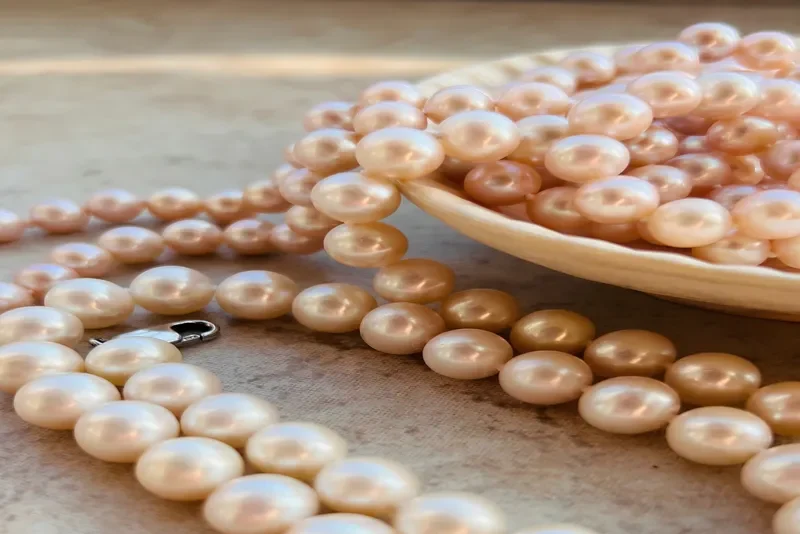

In recent years, the freshwater pearl market has continued to heat up, but this has also led to a constant stream of counterfeit products. From cheap plastic and glass beads to “recycled pearls” made by re-pressing pearl powder, and “coated pearls” with special surface coatings, counterfeiting methods are constantly evolving. As a consumer, it is crucial to master basic identification techniques. Today, we’ll take a detailed look at some of the most practical techniques for distinguishing genuine from counterfeit freshwater pearls.
I. First, let’s take a look at the types of fake pearls available on the market.
Before you learn how to identify them, you must first know the most common types of imitation pearls on the market include the following:
1. Plastic imitation pearls: Made of plastic/resin with a pearlescent coating;extremely lightweight, with a smooth, texture-free surface; the coating peels off easily.
2. Glass imitation pearls: Made with a glass core and pearl-effect paint, they feel cold to the touch, have an overly perfect surface, and a flat, lifeless luster.
3. Pressed Pearl Beads: Made by pressing pearl powder and a binder together; they have a certain heft but lack the layered structure of natural pearls.
4. Shell beads: Made with a shell core and a coating; their density is similar to that of real pearls, but their luster lies on the surface and lacks depth.
II. Several Simple Identification Methods
Tip 1: Rub Two Pearls TogetherThis is widely recognized in the jewelry industry as the simplest and most effective method of identification.
✅Real pearls: They feel gritty when rubbed and may produce a small amount of pearl powder (which can be wiped away).
❌ Fake pearls: They feel very smooth when rubbed, or if the coating is of poor quality, the coating may peel off.
⚠️ Note: Be sure to handle them gently to avoid damaging the surface of the pearls. If a small amount of white powder appears after rubbing, it is extremely fine pearl dust; simply wipe it away gently—it does not affect the quality of the pearls.
Tip 2: Texture and Temperature Hold the pearl in the palm of your hand or gently press it against your cheek to feel the change in its temperature.
✅ Real pearls: They feel slightly cool to the touch at first but gradually warm up as they come into contact with your body heat. This is because natural pearls are organic gemstones with good thermal conductivity.
❌ Fake Pearls: Plastic imitations feel distinctly “plastic-like” and do not warm up with body heat; glass imitations remain cool for a long time and cannot absorb body heat.
In addition, real pearls have a noticeable weight and feel substantial in the hand, while plastic or resin imitations are noticeably lighter and feel “flimsy” when worn.
Tip 3: Visual Inspection (Can Be Determined with the Naked Eye)
1. The luster—is it “subtle” or “flashy”?
The luster of natural pearls radiates from the inside out, offering a sense of depth and dimension. When high-quality freshwater pearls are turned in the light, you can even see a soft iridescence (orient). In contrast, the luster of imitation pearls often lies on the surface—it is either a lifeless, “plastic-like” sheen or an overly shiny “mirror-like” sheen—lacking the warm, understated texture of natural pearls.
2. Imperfections—“Perfection” Is Actually a Giveaway
Natural pearls are produced by mollusks, so it is virtually impossible for them to be flawless. Upon close inspection, genuine freshwater pearls will invariably have some subtle growth lines, slight irregularities, or variations in color. Imitations, on the other hand, often have surfaces that are too perfect, with each pearl as smooth as a mirror—and this is precisely their biggest giveaway.
3. The Shape—Be Wary of Pearls That Are “Too Round”
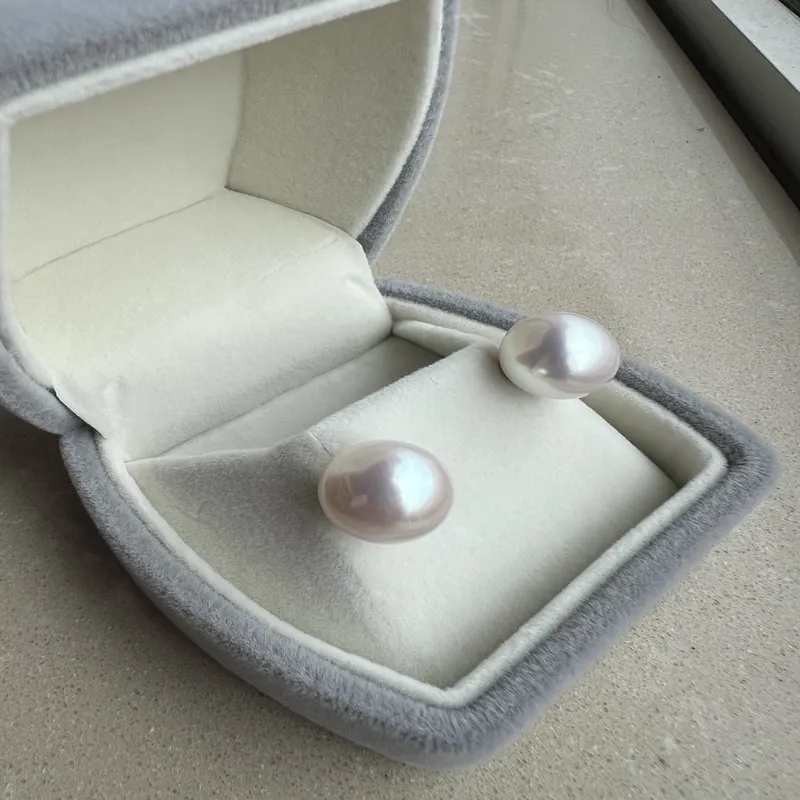
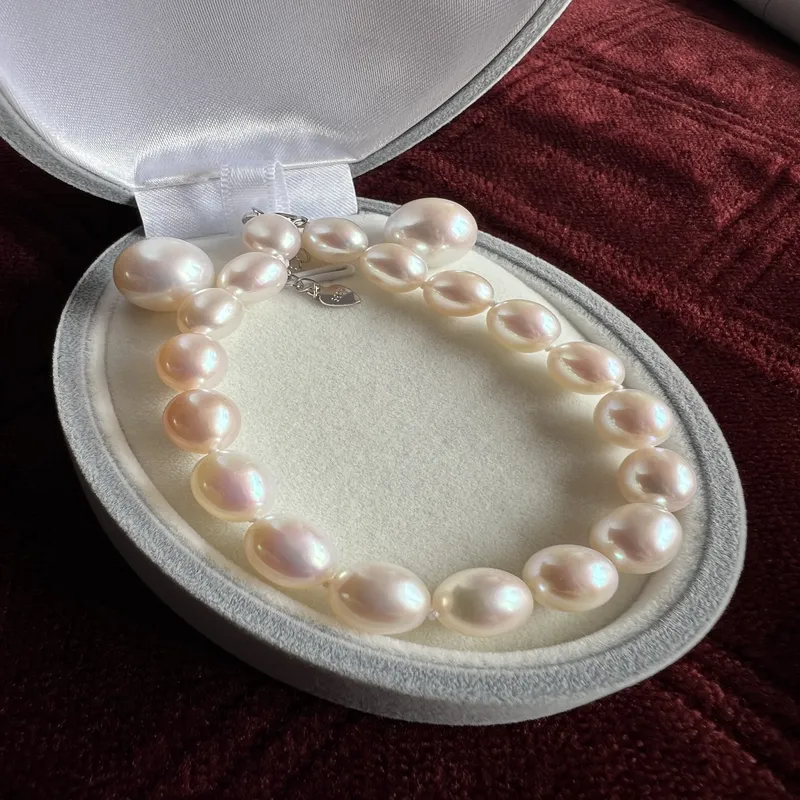
Freshwater pearls (especially those cultivated without a nucleus) rarely achieve a perfectly round shape. If you come across a strand of pearls where every pearl is perfectly round, exactly the same size, and completely flawless, yet the price is unusually low, it is almost certainly a fake.
4. Examine the Drilled Hole—The Details Reveal the Truth
Carefully examine the edges of the drilled hole in the pearl with a magnifying glass or the naked eye:
✅ Real pearls: The edges of the drilled hole are smooth, and the layered structure of the nacre is visible on the inner wall of the hole.
❌ Fake pearls: The drilled hole may show peeling coating, uneven edges, or visible traces of paint buildup around the hole.
Tip 4: Magnifying Glass Inspection (Advanced Identification)
Use a 10x jewelry magnifying glass to carefully examine the surface of the pearl:
✅ Real pearls: The surface shows irregular, wavy growth lines or crisscrossing nacre patterns—these are natural traces of the pearl’s layered growth.
❌ Fake pearls: The surface may show signs of paint brush strokes, air bubbles, or color spots caused by an uneven coating. Under a magnifying glass, pearls made from compressed pearl powder may appear grainy and lack the layered texture of natural pearls.
III. Advanced Authentication Methods (Used by Professional Organizations)
For high-value pearls, jewelry appraisal agencies typically use the following methods:
-X-ray examination: X-rays clearly reveal the internal structure of a pearl. Natural pearls exhibit distinct growth rings, while imitations have a uniform internal structure or contain an artificial nucleus.
-Density testing: The density of natural pearls typically ranges from 2.60 to 2.85 g/cm³, whereas imitations made from different materials exhibit significant variations in density.
-Ultraviolet fluorescence reaction: Some natural pearls exhibit a specific fluorescence reaction under ultraviolet light, whereas imitations do not.
These methods require specialized equipment and are not recommended for consumers to perform on their own. When purchasing high-value pearls, it is advisable to request an authoritative certification report.
Determining the authenticity of freshwater pearls isn’t actually as difficult as you might think. Once you’ve mastered the tips above, you’ll be able to quickly spot counterfeits in most cases.
Of course, you shouldn’t rely solely on these methods—price is also an important factor to consider. The chances of buying a perfect pearl for a bargain price are virtually zero.
Additionally, choose a reliable seller who provides transparent information and builds long-term trust.
If you have any questions about freshwater pearls,just contact Suzhou Lustre.